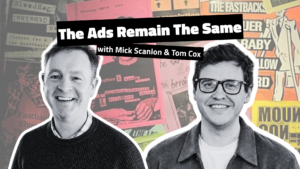
The Ads Remain the Same: Fake Plastic Trees
Is AI making advertising more creative, or are we at risk of filling the world with polished, soulless content? In episode five of The Ads Remain the Same, Tom and Mick explore the growing influence of AI on advertising, the importance of human creativity and why sometimes, less really is more. The Ads Remain the Same is a Footprint Digital podcast hosted by Mick, Head of Paid Media, and Tom Cox, Senior Paid Media Manager. Listen to the episode on YouTube: https://www.youtube.com/watch?v=UtHp-bzeP5A
AI has become almost impossible to escape. Whether you’re scrolling through LinkedIn, speaking to colleagues or keeping up with the latest developments in digital marketing, it seems that every conversation eventually comes back to artificial intelligence.
And while there’s no denying the opportunities it presents, there’s an increasingly interesting question emerging for marketers: just because we can create almost anything with AI, does that mean we should?
In episode five of The Ads Remain the Same, Tom and Mick take a closer look at the visual side of AI-generated advertising, questioning whether the technology is genuinely making creative work more accessible or simply making everything look a little bit the same.
From questionable AI-generated adverts featuring lawyers who are actually lions in suits, to the importance of creative limitations, the changing role of paid media marketers and the enduring appeal of a slightly imperfect live music performance, there’s plenty to get into.
The illusion of creativity: Is AI making advertising boring?
The starting point for this episode is the sheer volume of AI-generated content now appearing across advertising and social media.
With tools readily available to create images, videos and even sound files, it’s never been easier to bring an idea to life. You no longer necessarily need a camera crew, a video editor or a graphic designer to produce something that looks reasonably polished.
On the surface, this sounds like a positive development. More people can experiment with creative ideas, businesses with smaller budgets can produce content that might previously have been out of reach, and marketers have a growing number of tools at their disposal.
However, they raise an important distinction between having the ability to create something and actually being creative.
Knowing how to use a tool to generate an image doesn’t necessarily mean you understand how to compose a photograph. Being able to produce a video doesn’t automatically give you an understanding of filmmaking, storytelling or how to build an emotional connection with an audience.
There’s a risk that we’re creating an illusion of creativity, where the technology is doing much of the work and the person behind it is simply providing instructions.
Mick highlights the seven-minute AI-generated trailer for Elon Musk’s alternative version of Christopher Nolan’s The Odyssey as an example. Despite being technically impressive, the result left both questioning whether it had any real emotional substance.
The characters might look realistic, but something is missing. Their expressions, movements and interactions don’t quite feel natural, and there’s little sense of empathy or connection with what’s happening on screen.
One particular scene involving a woman running through a field to find a missing baby illustrates the problem. The characters appear to move between distances without the usual visual cues you’d expect from a film, making the sequence feel disorientating rather than immersive.
It’s a reminder that realism and believability aren’t necessarily the same thing.
Even when AI-generated content looks convincing at first glance, there’s often something about it that doesn’t quite sit right. The technology might be able to recreate the appearance of a human being, but capturing the nuances of human behaviour and emotion is another challenge entirely.
When more isn’t necessarily better
One of the central themes of the conversation is the idea that having unlimited creative possibilities might actually be limiting our imagination.
AI tools allow users to throw almost anything into an image. Want a dramatic landscape, a helicopter, an elephant and a dinosaur in the background? There’s probably a prompt that can make it happen.
But does that make the end result any better?
Mick uses the work of graphic designer Saul Bass as an example of why simplicity can be so powerful. Known for his iconic film posters, including those for Alfred Hitchcock’s Vertigo, Bass created striking designs using relatively few colours, simple shapes and carefully considered compositions.
Rather than filling every available space, his work relied on a small number of strong visual ideas.
The result was advertising that was instantly recognisable, memorable and genuinely interesting.
It’s difficult to imagine those designs benefiting from having more and more elements added to them. Their strength came from knowing what to leave out.
Tom agrees that a lot of AI-generated content currently feels as though no creative stone has been left unturned. The visuals are often garish, overly polished and packed with unnecessary details. There’s almost a recognisable AI aesthetic, from the slightly strange colour grading to the excessive visual effects and that familiar yellowish hue.
The same issue is appearing in video content. Tom describes some of the AI-generated moving images as a sort of ‘Ken Burns plus’ effect, where a still image is given movement without necessarily creating a convincing or meaningful sequence.
The technology can produce movement, but that doesn’t mean the movement serves a purpose.
For marketers, this raises an interesting question about whether we’re becoming so focused on what AI can do that we’re forgetting to consider what the audience actually needs to see.
When AI gets the brief wrong
Tom shares an example from his own experience of using Meta’s generative AI features when creating campaigns.
The platform increasingly encourages advertisers to turn static images into video content, suggesting that doing so could help generate more clicks.
For one client specialising in children’s party entertainment, Tom uploaded an image of an entertainer surrounded by children enjoying themselves. The intended focus was very much on the children and the experience they would have at the party.
However, Meta’s AI-generated variations took the image in a completely different direction, zooming out and presenting the entertainer almost like a stage performer.
Technically, it had created something from the original image. But it had missed the point of the advert entirely.
The focus should have been on making children feel special, not making the entertainer the star of the show.
It’s a relatively simple example, but it highlights a bigger issue with automated creative. Without someone understanding the context, audience and objective behind an image, the technology can easily produce something that looks plausible but communicates the wrong message.
And this becomes even more important when we’re dealing with sensitive or high-trust industries.
Lions in suits and the problem with AI-generated advertising
One of the more memorable examples discussed in the episode is a series of adverts from Injury Lawyers 4 U.
Tom explains how he’s been served several of their adverts across Google, Meta and TikTok, featuring AI-generated scenarios involving accidents and injuries.
The creative includes lions and tigers dressed in suits, alongside situations such as a man falling over in a gym, a child being bitten by a dog and a cyclist falling into a pothole.
While the concept might be intended to grab attention, the execution raises some questions.
The movements look awkward, the physical interactions don’t quite make sense and the characters lack the natural expressions and reactions you’d expect from real people.
In one example, a mother appears to run on the spot as her child is involved in an incident with a dog. In another, the sequence of a man falling in a gym feels strangely disconnected from the action taking place.
Tom also explores the brand’s variations in Meta’s advertising library, where the same basic concepts appear to have been repurposed into different six- and 15-second versions.
Rather than feeling like a carefully developed creative campaign, the adverts give the impression of templated variations being produced at scale.
Perhaps most interestingly, the TikTok comments on one of the adverts were switched off.
This leads to a discussion about whether the approach is deliberately designed to be so unusual that people stop scrolling and talk about it.
There’s always the argument that any publicity is good publicity, and perhaps the slightly bizarre nature of the adverts is intended to generate brand recognition.
After all, some people might genuinely enjoy seeing lawyers represented as lions in suits.
However, there’s a difference between being memorable and creating the right impression.
For a solicitor’s firm, trust and professionalism are particularly important. People generally seek legal representation because they’re dealing with something difficult or sensitive. They need to feel confident that the business understands their situation and can help them.
If the advertising looks rushed, impersonal or poorly thought through, could that undermine the very trust the business needs to establish?
It’s also worth considering whether the approach is simply a way of producing large volumes of content quickly and cheaply, rather than investing in a more considered creative strategy.
The question isn’t necessarily whether AI should be used in advertising, but whether businesses are thinking carefully enough about how they’re using it.
Are advertising platforms deciding how we advertise?
The conversation then moves beyond the creative itself and towards the platforms that are increasingly shaping how marketers work.
Tom raises an interesting point about whether the platforms’ priorities are becoming misaligned with what brands actually want to achieve.
Google and Meta are constantly encouraging advertisers to adopt new features, automate more of their campaigns and optimise towards more clicks and traffic.
But are clicks really the ultimate measure of success?
Mick argues that marketing should still be about building relationships with potential customers, not simply finding people who are ready to buy something immediately.
Of course, reaching someone who is actively searching for a product or service is valuable. But sustainable growth also comes from creating familiarity with a brand before someone is ready to make a purchase.
People need to know you’re there. They need to recognise your brand, understand what you offer and develop a level of confidence in what you do.
That relationship-building element can be lost when everything is measured through immediate clicks and conversions.
There’s also an interesting contradiction emerging as platforms increasingly automate the targeting and delivery of advertising.
As discussed in the previous episode, developments such as Google’s AI Max are changing how much control advertisers have over keywords, targeting and the way their ads are matched to audiences.
If the platforms are increasingly making those decisions, what control do marketers have left?
One area where advertisers still have a relatively visible role is the creative itself. They can provide images, videos and other assets, or allow the platforms to generate additional variations using AI.
Perhaps this is one reason why AI-generated creative has become such a prominent topic. It’s an area where marketers can see the technology making direct changes to their work.
However, Tom and Mick question whether the platforms’ focus on automation and optimisation is encouraging a way of working that prioritises clicks over the wider needs of a brand.
The challenge for marketers is to make sure that the technology doesn’t dictate the strategy.
Using AI as a creative partner, not a replacement
Despite their reservations, neither Tom nor Mick is suggesting that marketers should avoid AI altogether.
Both recognise that it has a valuable role to play, and the conversation becomes particularly interesting when they discuss how they’re using it in their own work.
Tom explains that he increasingly sees AI as a way of bringing an existing idea to life, rather than expecting it to come up with the entire idea in the first place.
He uses his work with Dunlop as an example.
When the brand was promoting its involvement with the ATP Tour around the Australian Open, Tom had the idea of creating adverts that were upside down to reflect the Australian setting.
Rather than immediately asking AI to produce the finished creative, he used it to explore the idea and consider whether it would work in practice.
It helped him think about potential issues, such as how the creative might appear on smaller mobile placements, where text would already be difficult to read.
In this situation, AI acted as a second pair of eyes, offering another perspective and helping him develop the original concept.
Tom has even given his AI assistant a name: Peggy, after Peggy Olson from Mad Men.
The idea is to have someone to bounce ideas off, challenge his thinking and help explore different creative possibilities.
He’s also used it to develop campaign mock-ups, taking an idea created in Canva and asking AI to visualise how it might look on a billboard or other out-of-home placement.
This can be particularly useful when presenting campaign ideas to clients. Sometimes it’s difficult to get someone excited about an idea until they can actually see what it might look like.
AI can help bridge that gap, turning an abstract concept into something tangible.
However, Tom is clear that he wouldn’t simply take the first thing AI produces and put it straight into an advertising account.
The final creative still needs to feel like his work, and it needs to be refined, considered and appropriate for the client.
Mick takes a similar approach, highlighting the importance of having an idea before opening an AI tool.
He doesn’t want to start with a blank screen and ask the technology to come up with something on his behalf.
Instead, he believes the human should bring something to the process first, remain in control of the direction and make the final decisions about what gets approved.
There’s also a danger of becoming too easily influenced by AI’s responses.
As Mick points out, AI can be very agreeable. Ask whether an idea is any good and there’s a reasonable chance it will tell you that it’s brilliant.
That can be useful for building confidence, but it isn’t necessarily helpful when you need someone to challenge your thinking.
If you’re not careful, you can end up being flattered into pursuing an idea that isn’t particularly good.
The important thing is to remember who’s directing the process.
As Tom puts it, if he drives AI too much, it stops being his idea. He doesn’t want to look back on his career and realise that the creative work he was proud of wasn’t really his in the first place.
AI should support the creative process, not take ownership of it.
Why creative limitations can be a good thing
One of the more thought-provoking parts of the episode comes when Mick reflects on his earlier career working in local press and print advertising.
Back then, there were fewer formats, less data and far fewer ways to reach an audience.
There were also more obvious creative limitations.
However, he argues that these restrictions could actually help people become more creative.
When you have a defined space, a limited set of materials or a deadline to work towards, you have something to focus on.
Without those boundaries, the possibilities can become overwhelming.
Mick refers to Apple’s controversial ‘Crush!’ advert, which showed creative tools and objects, including musical instruments and paint, being compressed into an iPad.
The message was essentially that all these creative possibilities could now exist within one device.
But Mick questions the idea that removing limitations automatically makes someone more creative.
In fact, having too many possibilities can make it harder to know where to begin.
He compares it to writing. Without a deadline, you could keep working on something indefinitely, but that doesn’t necessarily mean the end result will be any better.
Sometimes the pressure of having just half an hour to finish something forces you to focus, make decisions and produce your best work.
The same principle applies to advertising.
Working within certain creative constraints can encourage people to think more carefully about the message and how best to communicate it.
Mick also shares a personal experience from his early career, when his line manager challenged him to produce something more creative and distinctive than the standard newspaper advertising layouts being produced by his colleagues.
When Mick presented his first big piece of work, his manager wasn’t impressed.
It wasn’t what he wanted, and Mick had to go back, rethink the idea and start again.
It was an important learning experience because he acted as a genuine critical friend. He wasn’t there simply to tell Mick that everything looked great. He was there to challenge him and help him improve.
That kind of feedback is incredibly valuable, and it’s something that can be difficult to replicate with AI.
While AI can offer suggestions and alternative perspectives, it doesn’t necessarily have the experience or judgement to recognise when something simply isn’t good enough.
For people entering the marketing industry today, particularly those who have grown up with these tools, Mick’s advice is to become their own harshest critic.
Just because something is easy to create and looks impressive doesn’t mean it’s interesting, effective or original.
Could human creativity become a competitive advantage?
The discussion then turns to how audiences perceive AI-generated advertising and whether human creativity could become a selling point in its own right.
Mick mentions a pub in Dublin that reportedly banned AI-generated posters because it wanted to continue supporting local artists and the creative community around it.
For a business surrounded by people who value handmade products and artistic work, using AI to produce its advertising would have felt at odds with its identity.
It’s an interesting example of how a brand’s approach to creativity can reflect its wider values.
Mick also recalls seeing an alcohol brand’s glow-in-the-dark advertising in a London Underground tunnel, which included a label identifying it as AI-generated.
This raises the question of whether we’re moving towards a situation where audiences will increasingly want to know how advertising has been created.
During the episode, Mick references a YouGov survey from July 2026, which found that 76% of UK adults who had seen AI-generated actors in adverts disliked them, while 78% said they would be less trusting of a brand using AI-generated actors.
These figures suggest that audiences may be more cautious about AI-generated content than some businesses realise.
However, the conversation also recognises that people aren’t necessarily against AI itself.
If the technology is being used to produce something interesting, useful or genuinely entertaining, audiences may still engage with it.
The issue is when brands appear to be using AI as a shortcut, producing large volumes of low-quality content without much thought behind it.
There’s a difference between using technology to improve an idea and using it to avoid investing in creativity altogether.
For businesses operating in industries where trust is particularly important, that distinction could become increasingly significant.
It also presents an opportunity for competitors to take a different approach. If one brand is producing obviously AI-generated content, perhaps another can stand out by creating something more human, relatable and considered.
The question is whether audiences will reward that difference, and it’s something that could be interesting to measure.
Are we being hypocritical about AI automation?
Towards the end of the main discussion, Tom puts another interesting question to Mick.
Are marketers being a little hypocritical when it comes to AI?
After all, we’re quite happy to let Google automate bidding strategies, placements and other aspects of campaign delivery. Yet when the conversation turns to AI-generated visuals, there’s suddenly much more resistance.
Mick agrees that there’s an element of hypocrisy, although he suggests that part of the reason is how visible the different types of automation are.
When it comes to creative, marketers can see exactly what AI is producing. They can upload an image, watch it change and decide whether they like the result.
The bidding and delivery side of advertising is much less visible.
Platforms provide buttons and recommendations to optimise campaigns, but advertisers don’t necessarily have the same understanding of what’s happening behind the scenes.
There was a time when paid search was much more straightforward. You could select a keyword and have a reasonable understanding of when your advert would appear.
Now, there’s far more automation happening behind the interface, and marketers have less direct control over individual elements of campaign delivery.
Perhaps that’s why the creative side of AI attracts so much attention. It’s the part of the process where marketers can still see and influence the output.
However, Mick believes it’s important to recognise that these changes are part of a much wider shift in the industry.
The role of a paid media marketer is already changing. Where the job might once have involved spending around 80% of the time building campaigns, writing copy and creating assets, with 20% focused on strategy, that balance is increasingly reversing.
The work is becoming less about manually setting everything up and more about strategy, oversight and understanding how to get the best from increasingly automated platforms.
But there’s another element that shouldn’t be lost along the way.
The most important thing is still trust
If there’s one point that both Tom and Mick keep coming back to, it’s the importance of trust.
For Mick, advertising has always been about communication. It’s about creating a connection between a business and the people it wants to reach.
Yet as digital marketing becomes increasingly focused on data, optimisation, traffic and clicks, that human element can sometimes get pushed into the background.
You can generate more content, reach more people and produce more variations of an advert than ever before. But none of that necessarily means you’re building a stronger relationship with your audience.
Tom agrees, highlighting that trust is fundamental to paid media. People need to feel confident enough in a brand to click its adverts, visit its website and ultimately become customers.
The technology can help us get in front of people, but it can’t automatically create that confidence.
Both are also concerned about the wider impact of AI on the creative industries, particularly the potential reduction in opportunities for junior creatives and the people who traditionally support advertising production.
If businesses increasingly choose automated solutions over photographers, designers, videographers and creative teams, there’s a risk of losing some of the experience and talent that makes good advertising possible in the first place.
And once those skills and industries disappear, rebuilding them won’t necessarily be easy.
The challenge for marketers is to embrace the opportunities AI provides without losing sight of what makes their work valuable.
Technology can help us work faster and explore more possibilities, but human judgement, experience, creativity and communication remain essential.
Ultimately, the objective shouldn’t simply be to produce more advertising. It should be to produce better advertising that gives people a reason to notice, engage with and trust a brand.
The music: celebrating the imperfections of real creativity
Of course, it wouldn’t be The Ads Remain the Same without a little diversion into music.
And given the episode’s discussion about AI, creativity and the importance of human imperfections, the musical recommendations provide a particularly fitting way to round things off.
Mick kicks things off with a bit of a U2 double feature.
His t-shirt celebrates Rattle and Hum, the band’s 1988 documentary and concert film, which combines black-and-white and colour footage from their Joshua Tree tour.
He’s been revisiting U2’s back catalogue following the announcement of their upcoming European tour dates, with Tottenham Hotspur Stadium among the venues. Having seen the band around seven times already, Mick is very much planning to be at his laptop when tickets go on sale.
His album of the week is Under a Blood Red Sky, the live album recorded at Red Rocks Amphitheatre in Denver.
Released in 1983, the album captures an earlier version of U2, full of energy and enthusiasm. It features tracks such as New Year’s Day, alongside Party Girl, a song that Mick points out was rarely performed live.
What makes the album particularly enjoyable for him is its rawness. It’s not a flawless performance, and there are a few moments where things don’t quite go to plan.
But that’s part of its appeal. You get a sense of the band throwing themselves into the music, and the atmosphere of the live performance comes through.
Tom’s t-shirt takes things in a heavier direction, celebrating Black Sabbath, a band that has had a huge influence on his musical tastes.
He’s particularly interested in the world of stoner rock, sludge and doom metal, and the way bands build on the influences of those who came before them.
He talks about discovering bands through other bands, exploring the connections between musicians and genres, and getting his dad into Queens of the Stone Age.
That shared interest has taken them to see bands such as Sleep at Desertfest in Camden, and it’s even led to his dad discovering some rather unusual band names of his own, including Mammoth Weed Wizard Bastard.
Tom’s album recommendation, however, is a little more melodic.
He’s chosen Good Timin’: Live at Knebworth England 1980 by The Beach Boys, a recording of the band’s 1980 performance at Knebworth, which wasn’t officially released until 2002.
The concert is particularly significant because it was the last time all six members of the group performed together in the UK.
Tom is fascinated by the band’s harmonies and the way their music is put together, particularly the work of Brian Wilson.
He talks about the creativity behind albums such as Pet Sounds, recalling footage of Wilson in the recording studio, where he would ask musicians to swap instruments and experiment with unexpected sounds.
It’s a fascinating example of someone using the tools and people available to him to create something genuinely distinctive.
The album also features a particularly memorable performance from Dennis Wilson, who sings a cover of Joe Cocker’s You Are So Beautiful.
For Tom, it’s one of those moments that makes you stop and go back to listen again.
The conversation then turns to the importance of live music and why recordings of real performances can be so special.
Tom explains that one of the things he loves about live albums is hearing the imperfections. You get the little mistakes, the nuances and the audience reacting in real time. It’s a performance that happens once, and you can’t necessarily recreate it.
Mick recalls George Michael talking about imperfections in music, explaining that even when you’re a technically brilliant performer, there’s something special about those moments that feel a little more raw and real.
They discuss his unforgettable performance of Somebody to Love at the Freddie Mercury Tribute Concert, particularly the rehearsal footage, which shows just how extraordinary his voice was.
It’s a fitting end to an episode that has spent so much time questioning whether technology can truly replicate human creativity.
Because while AI might be able to generate an image, compose a piece of music or produce a convincing-looking video, there’s something about the spontaneity of a live performance that is difficult to manufacture.
Sometimes, the imperfections are exactly what make something memorable.
Final thoughts: keeping the human element in advertising
Episode five of The Ads Remain the Same raises some important questions about the direction of digital advertising.
AI is already changing how campaigns are created, how platforms operate and what marketers spend their time doing. There’s no realistic expectation that the technology will simply disappear, and there are plenty of reasons to embrace the opportunities it offers.
But the conversation between Tom and Mick highlights why it’s important not to confuse convenience with creativity.
The best use of AI might not be asking it to do everything for us. It might be using it to challenge our thinking, develop an idea, explore a different perspective or help bring something we’ve already imagined to life.
As advertising becomes increasingly automated, the ability to think critically, communicate effectively and create genuine connections with audiences could become even more valuable.
Because ultimately, people don’t build relationships with algorithms. They build relationships with brands that understand them, communicate with them and give them a reason to trust them.
And that’s something worth holding on to.


