
The Ads Remain the Same: PPC London Calling
In the first episode of The Ads Remain the Same, Footprint Digital’s Mick Scanlon and Tom Cox discuss the lessons from PPC London, the growing role of AI in paid media, their early experiences with Google’s AI Max, and what some of today’s biggest advertising campaigns can teach us about connecting with an audience. The Ads Remain the Same is a Footprint Digital podcast hosted by Mick, Head of Paid Media, and Tom Cox, Senior Paid Media Manager. Listen to the episode on YouTube: https://www.youtube.com/watch?v=H-HS8hdgliQ
Marketing is an industry that never stands still. Platforms evolve, technology advances and new tools promise to transform the way we work. Yet, amid all this change, some of the principles that make marketing effective remain remarkably consistent.
That is the thinking behind The Ads Remain the Same, a new podcast from Footprint Digital’s paid media team. Hosted by Mick, Head of Paid Media, and Tom, Senior Paid Media Manager, the podcast brings together industry experience, practical experimentation and plenty of discussion about the things that make them curious about marketing – plus it dips into their love of music!
In their first episode, Mick and Tom explore some of the biggest conversations happening in paid media, from the opportunities and limitations of AI to the importance of measurement, the value of human judgement and the difference between an advert that simply sells a product and one that makes people feel something.
They also look at some of the advertising campaigns that have caught their attention recently, both for the right reasons and the wrong ones, before finishing with a conversation about the music they have been listening to.
Why the fundamentals of advertising still matter
Despite their different routes into paid media, Mick and Tom share a fundamental interest in what makes marketing work.
For Tom, that curiosity comes partly from the ability to test an idea and see what happens. Having started his career in social media before moving further into paid media, he enjoys the combination of data, creativity and experimentation. Paid advertising offers a particularly immediate way to explore different approaches, measure the response and learn from the results.
Sometimes, the campaigns that perform best are not the ones you expected to succeed. That unpredictability is part of what keeps the work interesting.
Mick’s route into digital marketing began with copywriting. What drew him in was the opportunity to communicate with a much larger audience through advertising. Sixteen years into his career, that interest in communication remains central to how he approaches marketing.
These perspectives reflect the thinking behind the podcast’s name. Technology changes, platforms introduce new features and campaign management becomes increasingly sophisticated. But beneath all of that, advertising is still about communicating something meaningful to the right people.
As Mick and Tom discuss, messaging can be subtle or direct, understated or attention-grabbing. There is no single approach that works in every situation. The important thing is understanding what you are trying to communicate and finding a way to make that message resonate.
It is a useful starting point for a conversation about an industry currently experiencing enormous technological change.
PPC London: The value of sharing practical ideas
One of the first subjects the pair explore is PPC London, where Tom had recently spoken at the inaugural event.
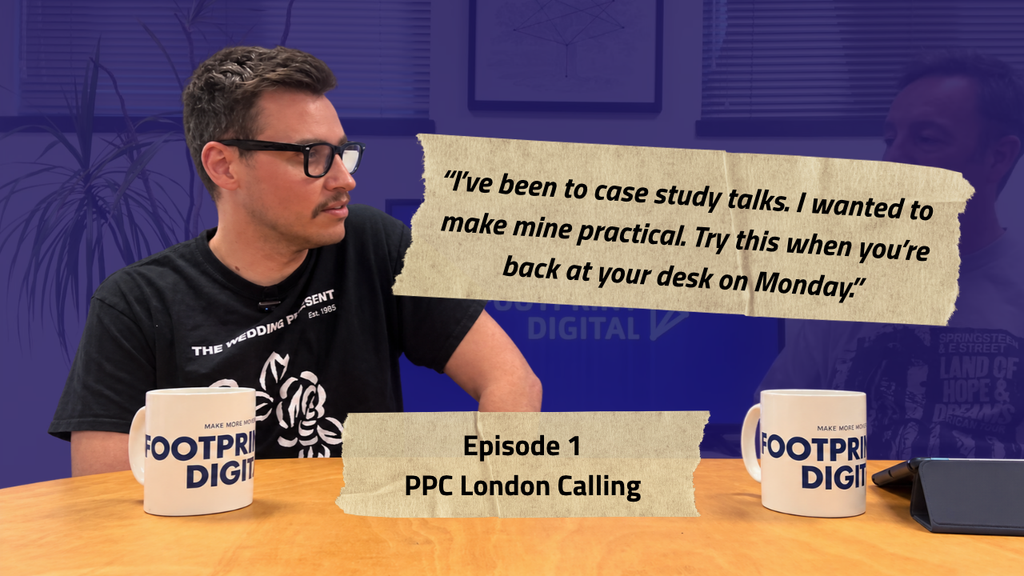
For Tom, the opportunity to speak was particularly valuable because it allowed him to share practical ideas that people could take away and try in their own campaigns.
His previous conference talk at BrightonSEO had focused more on tools and resources he found useful. For PPC London, he wanted to build on that approach by giving attendees ideas they could put into practice when they returned to work.
There is a familiar challenge when presenting to an audience of industry professionals: the worry that everyone already knows what you are about to say. Tom admits to feeling some of that apprehension, particularly when discussing tools that people can discover and use for themselves.
The response from attendees, however, reinforced the value of sharing knowledge. People were interested in the tools he discussed, asked questions about how they could apply them to their own industries and approached him afterwards to continue the conversation.
For Tom, that was an important reminder that everyone has a different perspective and level of experience. Something that feels familiar to one marketer might be completely new to another.
Finding useful insights in unexpected places
One of the tools Tom discussed was Reddit Pro, which can help marketers explore conversations and perceptions around brands and topics.
The value is not limited to consumer brands or industries that might traditionally generate lots of online discussion. Tom explains that the same approach could be used to explore how people talk about a law firm, for example, or to understand the perceptions surrounding a business operating in a more specialised sector.
The point is to use these tools to understand the conversations taking place around a brand, rather than relying exclusively on what a business thinks its audience wants to hear.
Tom also discussed resources such as Microsoft Clarity, which helps marketers understand how people interact with websites, and reports within Google Analytics 4 that can provide additional insight into user behaviour.
The broader lesson is that useful marketing insights are not always hidden behind expensive software or complicated processes. Sometimes, they come from exploring the tools already available and asking better questions of the information they provide.
This is particularly relevant for businesses operating in B2B and professional services, where it can be tempting to assume that the approaches used by consumer brands will not translate.
AI in PPC: From asking whether to use it to asking how
Artificial intelligence was one of the major themes at PPC London, and it is unsurprising that the conversation turns to its growing influence on paid media.
Mick reflects on how quickly attitudes towards AI have changed. Not so long ago, conversations with clients often involved reassuring them that AI was not something the agency was using. There were concerns about accuracy, reliability and whether using it meant taking shortcuts.
Now, the expectation is increasingly that marketers should be using AI. Clients want to understand what their agencies are doing with it, how it is improving efficiency and whether they are making the most of the opportunities available.
For Mick, this marks an important shift. The conversation is moving away from whether a business uses AI and towards how it uses it, why it uses it and what value it actually creates.
There are obvious benefits. At PPC London, speakers demonstrated ways of using AI to analyse data, improve reporting, develop tools and work through tasks that might previously have taken hours.
One particularly interesting example involved using auction insights and other available data to estimate competitors’ advertising spend. The process showed how AI could help uncover useful information from data that had effectively been hiding in plain sight.
Tom also describes how AI is helping the Footprint team speed up certain processes. Tasks that once took several days can sometimes be completed in a matter of minutes, particularly when working with large documents or complex datasets.
The potential is significant. More time can be spent interpreting information, developing ideas and working with clients, rather than manually processing data.
But Mick and Tom are equally clear that speed does not automatically translate into quality.
The danger of content that looks impressive but says very little
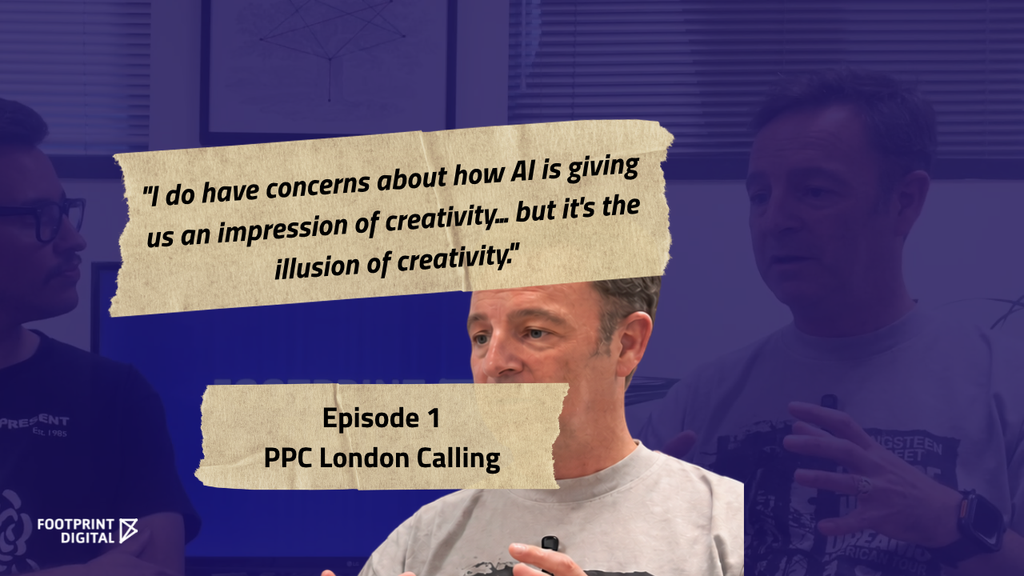
One of Mick’s main concerns is that AI can produce work that looks polished and professional without necessarily offering anything meaningful.
A report might be well structured, use convincing language and contain plenty of detail, yet still fail to provide a genuinely useful insight. An inexperienced reader might be impressed, while someone who understands the subject could quickly recognise that the analysis lacks depth.
Tom makes a similar point about context. AI can process information and identify patterns, but it does not necessarily understand the history behind every decision or the circumstances that explain why something happened.
In paid media, that distinction matters. A campaign’s performance cannot always be understood by looking at the numbers in isolation. Without that context, an analysis can tell a misleading story.
Mick argues that marketers need to understand both what they are asking AI to do and what they are receiving in return. Copying an answer into a report without checking it is not a meaningful use of the technology.
The same applies to content. If a marketer cannot explain or evaluate the information AI has produced, they are not in a strong position to judge whether it is accurate, relevant or useful.
There is also a risk that people become disconnected from their own work. If every analysis, report or recommendation is generated by a tool, without the marketer actively engaging with the process, they can lose the understanding needed to answer even straightforward questions about an account.
For Mick and Tom, the answer is not to reject AI. It is to use it with purpose, maintaining the human oversight needed to make sense of the output.
Google AI Max: Why experimentation still needs human oversight
The discussion around AI leads naturally to Google AI Max, which Mick and Tom have both been testing in paid search campaigns.
Google has been encouraging advertisers to adopt its increasingly automated features, promising opportunities to reach audiences beyond the searches and keywords marketers might traditionally target.
In theory, this is an attractive proposition. People are becoming more conversational in the way they search, using longer and more specific queries to describe what they need. AI-powered search experiences are accelerating this shift, creating opportunities for advertisers to connect with people whose needs might not be captured by conventional keyword research.
However, Mick and Tom’s early experiences with AI Max have left them with questions.
Tom explains that the feature has not consistently delivered the results he hoped for. Its usefulness appears to depend partly on the account, the industry and the quality of the information available to Google.
This is particularly important for businesses in regulated sectors such as insurance, healthcare and legal services. These organisations cannot always use broad or loosely controlled messaging. Their advertising needs to be accurate, appropriate and compliant with the relevant requirements.
Automation also depends on the quality of the website and landing pages it can draw upon. If the available content is weak, or if it is unclear which pages should be prioritised, giving a platform greater freedom to select destinations and generate creative assets can introduce additional risks.
Tom describes situations where he has needed to restrict certain features because the landing pages or creative assets were not suitable for broader automation. Once those options were limited, however, the results did not necessarily demonstrate the wider reach or improved performance he had hoped to see.
Mick shares the experience of a client that tested AI Max over several weeks. The intention was to understand whether the feature could improve campaign performance, with the expectation that a successful test might lead to wider adoption.
The results did not exceed expectations. At best, performance was broadly comparable with what had been achieved previously. In some cases, the team was concerned that the test might have affected performance elsewhere in the account, making it harder to establish whether the apparent results represented genuinely incremental gains.
That distinction is important. A campaign can appear to perform well without necessarily generating additional value for the business. If it is simply capturing conversions that would otherwise have come through another campaign, the overall impact may be less impressive than the individual figures suggest.
The team also found that the search terms generated during the experiment did not show the dramatic expansion they had expected. Much of the activity looked similar to what they had already been seeing, raising questions about whether the feature was reaching genuinely new audiences in the way Google had suggested.
There were further concerns about irrelevant searches appearing despite the restrictions put in place. Mick refers to examples from other testing, including searches for Taylor Swift concert tickets and children’s entertainment that had little relevance to the advertiser involved.
These experiences do not mean AI Max cannot work. Mick and Tom acknowledge that results may vary between industries, account structures and campaign types. They also recognise that new features can take time to mature.
Their concern is that advertisers should not be expected to switch on automation simply because a platform recommends it, particularly when client budgets and brand reputation are at stake.
Testing should be about learning, not just winning
One of the most useful points from the discussion is how Mick and Tom approach a test that does not deliver the expected result.
Rather than treating the experiment as a straightforward failure, they focus on what it has taught them. The findings can help them understand where the technology may be useful, which restrictions are necessary and how a future test could be structured more effectively.
That is the purpose of experimentation. It is not to prove that a new feature works at all costs, but to gather evidence that supports better decisions.
Mick also highlights a conversation with a client following the AI Max test. Rather than concluding that automation would make account management less necessary, the client recognised the opposite: the experiment had reinforced the value of having an experienced account manager overseeing the process.
This is a significant point in an industry where automation is often presented as a way to simplify campaign management. As platforms take on more responsibility for decisions, marketers need to understand what those systems are doing, whether their actions make sense and how they affect the wider account.
Automation does not remove the need for strategy. In many cases, it makes strategy and oversight more important.
Search is changing, but advertisers still need better insight
The AI Max discussion also opens up a wider question about how people search and how advertising platforms report on that behaviour.
Historically, keyword research has helped marketers understand what people are looking for. Search terms provide insight into the language people use, while paid search campaigns allow advertisers to test messaging and identify opportunities relatively quickly.
But search behaviour is becoming more conversational. Rather than entering a short phrase, someone might ask a much more detailed question, explaining their circumstances and what they need in a single query.
Mick and Tom see this as a meaningful shift in how people discover products and services. It could also change the relationship between different stages of the marketing funnel.
Consider someone whose swimming pool has turned green. They might begin by searching for an explanation, then discover that algae is the cause, explore ways to solve the problem and find a local business that can help. As search experiences become more capable of answering questions and connecting people with solutions, these stages can happen much closer together.
For marketers, understanding that journey would be extremely valuable.
Tom explains that he would like to see search reporting provide clearer insight into these longer, more conversational queries. Knowing that someone searched for a particular product is useful, but understanding the underlying question could help marketers develop more relevant advertising, website content and frequently asked questions.
Paid search can also provide a useful testing ground for organic search. The response to different messages and headlines can help inform wider content decisions, although the relationship between paid performance and organic rankings is not direct.
The challenge is that the reporting available to advertisers does not always appear to reflect the full extent of the changing search experience.
If people are increasingly using detailed prompts and natural language, marketers need ways to understand those behaviours and evaluate how their campaigns are responding. Without that visibility, it becomes harder to establish whether automation is genuinely reaching new audiences or simply redistributing existing activity.
For Mick and Tom, the direction of travel is clear, even if the tools and reporting have not yet caught up with every aspect of it.
What makes a good advert? Emotion, relevance and a little imagination
After spending much of the conversation discussing data, automation and campaign performance, Mick and Tom turn to something more creative: the advertising they have noticed recently.
One of Tom’s favourite recent examples is a series of advertisements promoting concerts at Colchester Castle Park.
The campaigns combine straightforward information with a more emotional message. Some adverts feature an artist, a clear call to action and a direct invitation to book tickets. These are familiar remarketing tactics, helping people who have previously shown an interest in an event take the next step.
But Tom is particularly taken with simpler creative that invites people to imagine the experience itself. One example uses footage of Simply Red performing, accompanied by the suggestion that audiences could enjoy a similar moment in Colchester Castle Park.
There is very little explanation. Instead, the advert allows the music to do the work, encouraging people to picture themselves at the event.
For Tom, this is a good example of advertising that does not feel like it is trying too hard to sell. He watched the video because it entertained him, and the experience helped him imagine attending the concert.
The power of simplicity
Mick points to Heinz as another brand that understands the value of a simple idea.
The brand has a long history, yet it continues to find ways to communicate the appeal of its products without needing to explain everything. Tom and Mick discuss a campaign that replaced the Heinz name with the name of a food commonly associated with its products, such as toast.
The idea relies on an existing cultural connection. Heinz beans and toast are familiar to many people, so the brand does not need to spell out the relationship. The audience understands it immediately.
Mick also highlights Heinz’s efforts to appeal to students through affordable product bundles. It is a practical approach that recognises the circumstances of a particular audience while introducing a familiar brand to people who may continue buying its products for years.
For him, this demonstrates the value of thinking beyond an individual campaign. Strong marketing can build relationships over time, bringing new audiences into the brand while reinforcing the reasons existing customers continue to choose it.
Both examples show that effective creative does not always require complexity. Sometimes, the strongest idea is the one that taps into something people already understand or feel.
When an advert leaves the audience confused
Not every campaign gets the balance right.
Tom discusses some short-form social adverts that have left him wondering what the product is, what the message means or why he should care. He recognises that social advertising has to compete for attention, particularly when people are scrolling quickly through their feeds. But he questions whether the drive to stop the scroll can sometimes come at the expense of context.
An advert can be visually striking or deliberately unusual without communicating anything meaningful. If the audience cannot work out what is being advertised, the creative may attract attention without creating the connection needed to influence a decision.
Mick offers a contrasting example in Heinz, whose advertising often strips the message back to a simple visual or cultural reference. The difference is that simplicity works when the audience can make sense of it.
The discussion also touches on the surreal style of some KFC advertising. Mick enjoys the campaigns’ unusual, sometimes absurd approach, while acknowledging that this kind of creative will not appeal to everyone.
That is part of the challenge of advertising. Creative choices are subjective, and different approaches can work for different audiences. But being distinctive is not the same as being effective. The creative still needs to serve a purpose and make sense in the context in which people encounter it.
The importance of getting the details right
Mick’s attention to advertising extends to the mistakes that can undermine an otherwise strong campaign.
While researching competitors’ advertising through platform transparency tools, he came across an advert for Shokz headphones that was still running with an offer dating back to February.
The wider campaign had caught his attention for positive reasons. Shokz had compelling creative, a clear product proposition and advertising that appeared relevant to the audience. Yet one outdated offer was enough to stand out as an avoidable error.
It is a reminder that automation can help marketers produce and distribute advertising at scale, but it also creates a need for effective checks. If creative assets are being combined or campaigns are being updated automatically, someone still needs to make sure the information being shown is correct.
Mick and Tom then discuss a more serious example involving Converse. A creative promoting a remastered version of a classic shoe design attracted criticism because the composition could be interpreted as evoking racist imagery.
Their concern is not simply that an advert made a mistake. It is that the creative had presumably passed through a series of reviews and approval processes before being released.
The example raises questions about how marketing teams evaluate the way their work might be interpreted by different audiences. A concept may appear to communicate one thing to the people who created it, but audiences encounter it without that background knowledge. They make judgements quickly, often based on the first impression an image creates.
Mick reflects on the idea that some brands might deliberately embrace provocative advertising to generate publicity. He recalls controversial campaigns from earlier in his life and questions whether the desire to create headlines can sometimes take precedence over the message a brand actually wants to communicate.
There is a difference between challenging an audience with a purposeful idea and relying on controversy simply to attract attention. The latter can create reputational damage without delivering any meaningful benefit to the business.
Tom adds that social platforms can reward unusual or provocative content with attention, potentially encouraging brands to push creative further in the pursuit of visibility. But the conversation leaves an important question: what is that attention ultimately worth if the audience’s reaction is negative?
For Mick, brand alignment matters. People form relationships with brands based on what those brands represent, and they can reconsider those relationships when a campaign conflicts with their values or expectations.
A campaign should not be judged solely on whether people notice it. Marketers also need to consider what people will think, feel and remember afterwards.
What marketers can take away from the conversation
Across their discussion of PPC London, AI, automation and advertising creative, Mick and Tom repeatedly return to the same underlying principle: technology and tactics are only useful when they support a clear marketing purpose.
AI can help marketers process data faster, uncover patterns and reduce the time spent on repetitive tasks. But the quality of the outcome still depends on the questions being asked, the information available and the judgement applied to the results.
Automation can expand the possibilities of paid search, but advertisers need to understand how it affects campaign performance and whether it is generating genuinely additional value. Testing new features is important, but so is being willing to question the results and learn from experiments that do not go to plan.
And while data can tell marketers a great deal about what audiences do, creative remains essential to explaining why they should care. A relevant message, a familiar cultural reference or a moment that helps someone picture an experience can be just as important as the technology used to deliver it.
Perhaps most importantly, the conversation highlights the value of remaining curious. Tom’s experience at PPC London reinforced that there is always something new to learn from other marketers, even when the tools and ideas being discussed seem familiar. Mick’s reflections on AI demonstrate why experience and critical thinking remain valuable in an increasingly automated industry.
The platforms will continue to change. New features will arrive, search behaviour will evolve and marketers will find different ways to reach their audiences. But the need to understand people, communicate clearly, test ideas and learn from the results is unlikely to disappear.
That is what The Ads Remain the Same is all about.
Now playing: the music behind the marketing
Naturally, no conversation between Mick and Tom would be complete without a discussion about music.
In keeping with the podcast’s musical theme, the pair finish the episode by sharing what they have been listening to. Tom talks about Protomartyr, whose dark, noisy post-punk sound has caught his attention, and recommends exploring the band’s back catalogue.
Mick discusses Public Service Broadcasting, particularly The Race for Space, an album built around the history of the space race and the Apollo missions. He describes how the band combines archival recordings and electronic elements with a more traditional musical foundation to create a story that is both engaging and uplifting.
They also touch on U2’s anniversary, live performances and the way music can create a connection that goes beyond the individual song.
It is a fitting end to a conversation about advertising. Whether through music, a memorable campaign or a well-timed message, the challenge is often the same: finding a way to capture someone’s attention and make them feel something.
And, as Mick and Tom make clear, that is a challenge worth continuing to explore.
The Ads Remain the Same is a Footprint Digital podcast hosted by Mick, Head of Paid Media, and Tom Cox, Senior Paid Media Manager. Listen to the episode on YouTube: https://www.youtube.com/watch?v=H-HS8hdgliQ
Related Categories
Previous
From Clay Pit to Historic Landmarks: Our Apprentice Challenge at Bulmer Brick & Tile Company