The Ads Remain The Same: Are You (User) Experienced
Driving traffic to a website is one thing. Turning that traffic into enquiries, sales and new customers is another.
In the second episode of The Ads Remain the Same, Mick and Tom get into what happens after someone clicks an advert. From landing page experience and conversion barriers to AI-powered campaign optimisation and the challenge of creating memorable advertising, the conversation explores why successful paid media is about much more than getting the click.
They also share some practical ways marketers can better understand their audiences, spot problems that might otherwise go unnoticed and work with clients to improve performance beyond the campaign itself.
The Ads Remain the Same is a Footprint Digital podcast hosted by Mick, Head of Paid Media, and Tom Cox, Senior Paid Media Manager. Listen to the episode on YouTube: https://www.youtube.com/watch?v=84leOoJ3rQ8
The click is only the beginning
Paid media specialists spend a lot of time thinking about targeting, bidding, creative, messaging and campaign structure. And rightly so. Getting those elements right is essential to reaching the right people and encouraging them to engage.
Landing pages have traditionally played an important role in this process, too. In paid search, for example, the relevance and quality of a landing page contribute to Quality Score, which can influence the cost and efficiency of your campaigns. Your keyword targeting, advert messaging and landing page all need to work together to create a coherent experience.
But as Mick and Tom discuss, it’s easy to become so focused on getting people to the website that we overlook what happens when they arrive.
As Tom explains, there’s only so much you can optimise within a campaign if the experience on the other side of the click isn’t working. You can bring in relevant traffic, achieve a healthy click-through rate and keep costs under control, but those improvements won’t necessarily translate into more conversions if users encounter problems once they’re on the site.
The landing page is also just one part of a much bigger picture. The entire journey matters, from the moment someone sees an advert to the point at which they make a purchase or submit an enquiry.
Does the page deliver what the advert promised? Can visitors find the information they’re looking for? Is the next step obvious? And is there anything making it unnecessarily difficult for them to complete their journey?
These questions might sound straightforward, but they can reveal opportunities that aren’t immediately apparent when looking at campaign performance alone.
Why user experience affects more than paid media
Although the conversation begins with paid advertising, the principles apply across digital marketing.
Someone arriving from a paid search advert might have a very different level of intent from someone clicking through from a paid social campaign. A search user could already be actively looking for a particular product or service, while someone on social media might be discovering a brand for the first time because an advert has caught their attention.
That difference affects what each person expects to find when they land on a website.
Someone who knows exactly what they want should be able to get to the relevant product or service quickly. Someone who is earlier in their decision-making process might need more context, reassurance or information before they’re ready to take action.
If both users are sent to a generic homepage and left to work things out for themselves, the experience could create unnecessary friction.
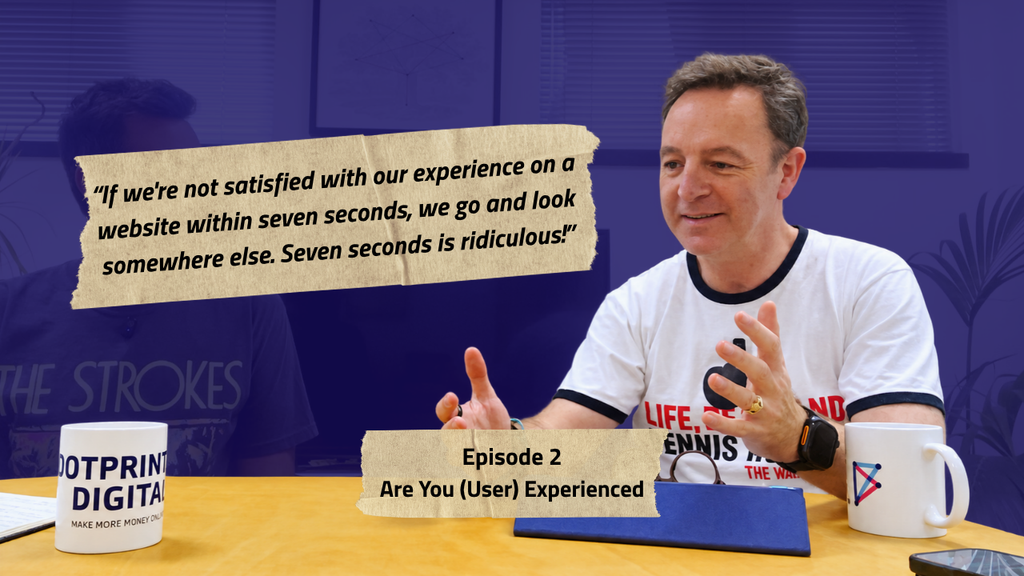
Tom highlights how quickly this can become a problem. If someone has to navigate through several pages to reach the information they were looking for in the first place, that’s an additional barrier. We have become accustomed to finding information quickly online, and when a website makes that unnecessarily difficult, there is always the possibility that we’ll go elsewhere.
The consequences aren’t limited to paid campaigns, either. A poor website experience can affect people arriving through organic search, social media, referrals and other channels.
This is particularly relevant as search continues to change. With AI Overviews and other AI-powered experiences providing more information directly in search results, users may arrive at a website having already found answers to some of their questions. If they do click through, the website needs to make the next step worthwhile.
Getting someone onto a website is still important, but what happens next deserves just as much attention.
Looking beyond the numbers with Microsoft Clarity
One of the key tools discussed in the episode is Microsoft Clarity, which Mick describes as a valuable addition to a digital marketer’s toolkit.
Clarity helps marketers understand how people actually interact with a website. Rather than relying exclusively on reports showing visits, clicks and conversions, it allows you to investigate user behaviour through session recordings and other behavioural insights.
The tool can also identify certain interactions automatically through its Smart Events functionality, which can help marketers explore important stages of the customer journey without having to configure every event manually. For those with more technical knowledge, setting up additional events can provide another layer of insight and confirmation.
Crucially, Clarity allows users to segment website behaviour by traffic source. This means marketers can investigate how people arriving from Google Ads behave compared with those coming from paid social or other channels.
That distinction matters because the same page might work well for one audience but create problems for another. Understanding the source of a visit, alongside the user’s behaviour once they arrive, can help explain why performance differs between campaigns.
Mick’s enthusiasm for the tool comes from seeing how useful this information can be when investigating a problem that traditional reporting doesn’t fully explain.
When a checkout problem looks like a marketing problem
One of the clearest examples from the episode involves a client selling tennis equipment, including Dunlop’s FX racket range.
The team was looking at the checkout journey for users arriving through paid campaigns. Using Clarity’s Smart Events, they could investigate what happened as people moved through the checkout process and identify where users were dropping off before completing a purchase.
They noticed a particular problem between the billing stage and successful purchase. Users in the UK, the US and Sweden were entering their address details and selecting their country, only to encounter an error when attempting to pay. The checkout would ask them to select a country, even though they had already done so. The form would then reset, clearing their information and forcing them to start again.
Some users were attempting to complete the process repeatedly, but the purchase still wasn’t going through.
This wasn’t a problem with the campaign targeting, the advert creative or the quality of the traffic. It was a technical issue with the website’s checkout experience.
Without investigating what users were actually doing, the performance data could have told a misleading story. The campaigns were generating traffic and attracting clicks, but purchases weren’t following. Looking at the reports alone, it might have appeared that those markets weren’t converting well or that the campaign needed to be adjusted.
In reality, the customer journey was broken at a crucial moment.
By identifying the issue through Clarity, the team could take specific evidence to the developers and explain what was happening. Mick also looked at the issue alongside GA4 data, which showed that the affected countries accounted for approximately a quarter of the market.
That helped put the problem into perspective. A technical error was potentially preventing a significant proportion of the audience from completing a purchase, regardless of how well the advertising was performing.
It’s a useful reminder that data needs context. Reports can show us where performance is falling short, but investigating user behaviour can help us understand why.
Without that additional insight, marketers risk spending time changing bids, targeting or campaign settings to address a problem that actually sits elsewhere.
The value of seeing what customers see
Tom also shares an example from an earlier client relationship involving a business selling music books and musical scores.
Despite operating in a market where there shouldn’t have been overwhelming competition, the paid campaigns struggled to generate the expected sales. The issue wasn’t necessarily a lack of demand or an inability to reach the right audience. The website experience itself was creating problems.
Examples like these demonstrate why it is so important to look at the customer journey from the user’s perspective, rather than assuming that a technically functioning website is necessarily an effective one.
A page can load correctly and still be confusing. A checkout can technically work while making the purchase process unnecessarily difficult. A service page can contain all the relevant information without making it clear what a visitor should do next.
Tools such as Clarity help reveal these problems, but the real value comes from using those insights to start the right conversations and make meaningful improvements.
AI is changing campaign optimisation, but the customer journey still matters
As the discussion develops, Mick and Tom turn to the role of AI in paid media, including Google’s AI Max features.
AI-powered campaign tools can increasingly make decisions about how adverts are served and which landing pages users are directed towards. AI Max, for example, can use website content to help select relevant landing pages and adapt ad text to better match a user’s search.
This creates new opportunities for campaign optimisation, but it also raises an important question: how much control should marketers hand over to automation if the website itself isn’t ready to deliver a good experience?
Automated systems can help connect a user with relevant content, but they cannot automatically solve every underlying problem with a website or guarantee that a page will answer the user’s needs.
If the selected page is confusing, out of date or missing important information, sending more relevant traffic towards it won’t necessarily improve conversion rates.
The conversation reinforces the importance of thinking about the whole journey, rather than treating campaign automation as a solution in itself.
It also highlights the need for closer collaboration between paid media specialists, SEO teams, content writers, web developers and clients. Each has a role to play in making sure that the message, the destination and the experience work together.
Paid media can help identify what your customers need
One particularly useful point in the discussion is the relationship between paid search and organic search.
Tom explains that paid campaigns can act as a testing ground for understanding what people are searching for, which messages resonate and what information they need before taking action. Those insights can then help inform wider website content and SEO activity.
This is especially valuable when an audience has a specific or complex requirement that a generic service page might not adequately address.
Mick illustrates the approach with an example involving travel insurance for people with specialist medical conditions.
Rather than treating all of these potential customers as one broad audience, he would start by researching the language people use when looking for cover. Searching Google and exploring forums such as Reddit can help reveal the questions people are asking, the concerns they have and the experiences they share.
For example, someone with diabetes may have different questions about travel insurance from someone with high blood pressure. Their circumstances, concerns and expectations may differ, even though both are looking for insurance related to a medical condition.
Those findings can inform the campaign structure. If the research reveals distinct needs, it may make sense to create separate ad groups that address those needs more specifically, with messaging that reflects the language people actually use.
From there, the landing page can be developed to answer the relevant questions, explain the service and provide appropriate reassurance.
The result is a more consistent journey. The search term reflects the user’s need, the advert addresses that need, and the landing page follows through by providing relevant information and a clear next step.
It also creates an opportunity to feed those insights back into organic content. If paid search data and audience research show that people are actively looking for specific information, that may highlight a need for more detailed website content.
This is where collaboration becomes particularly important. Paid media can help identify demand and test messaging, while SEO and content teams can use those findings to develop useful, relevant resources that support customers across a wider range of searches.
Why bespoke landing pages can be worth the effort
Of course, creating dedicated landing pages isn’t always straightforward.
As Mick and Tom discuss, marketers can encounter resistance when recommending changes to a client’s website. A client may feel that their existing service page is perfectly adequate, or question whether building a bespoke page for a paid campaign is worth the investment.
There are legitimate considerations. A dedicated page requires time and resources, and it needs to serve a clear purpose. It might not make sense to build a separate page for every variation of a keyword or audience.
However, when there is clear evidence that users have specific needs that the existing page doesn’t address, a bespoke landing page can be a useful way to improve the experience and test a more relevant approach.
It also doesn’t necessarily need to replace the existing organic landing page. Paid campaign landing pages can be developed and tested for a particular audience or objective, helping marketers understand whether a more focused experience improves results.
The important thing is to make decisions based on evidence rather than assumptions.
If users are actively searching for a particular service or asking specific questions, that can provide a strong case for developing content that responds to those needs. It gives the marketing team something tangible to discuss with the client and helps explain why the proposed change could be worthwhile.
Ultimately, the goal isn’t to create more pages for the sake of it. It’s to make sure that the right people arrive at a page that gives them what they need to take the next step.
Should search advertising be more creative?
The episode isn’t all about landing pages and analytics. Mick and Tom also discuss several advertising campaigns that have caught their attention, including work from Howdens, IKEA and ASICS.
Their conversation explores an interesting tension in advertising: the difference between communicating a product or service directly and creating something memorable enough to make people stop scrolling.
Tom discusses IKEA’s game-show-style advertising and ASICS’ wildlife-documentary-inspired campaign, narrated by Sigourney Weaver. Rather than simply showing furniture or running shoes, these campaigns use an unexpected format to capture attention and entertain the audience.
The approach brings to mind other memorable campaigns, including Cadbury’s famous gorilla advert and Guinness’ distinctive creative work. In these examples, the advertisement isn’t simply a straightforward demonstration of the product. It creates an association with the brand through a distinctive idea that people remember.
The challenge is making that creativity relevant. An entertaining advert still needs to build a connection between the idea and the brand, otherwise people may remember the campaign without remembering who created it or what it was promoting.
Mick and Tom also discuss Howdens’ Tradefest campaign, which uses famous album covers as a creative starting point. They appreciate the concept but question how well the execution connects with its intended audience, including the reactions and comments the campaign has attracted.
It’s a useful distinction: an advert can attract attention without necessarily creating the response a brand wants. Understanding the audience and the context in which the campaign appears is just as important as having an original idea.
Can paid search be more memorable?
The conversation then turns to how these ideas translate into paid search, where the creative options can feel more constrained.
Search adverts need to respond to a user’s query and communicate the relevance of a product or service. Advertisers are working with limited space, multiple headlines and descriptions, and the need to generate enquiries or sales.
That can encourage a very functional approach. Headlines explain what the business does, what it offers and why someone should choose it. These messages are important, but they can also make it difficult for one advert to stand out from the many similar options on a search results page.
Tom wonders whether there is more room for distinctive copy and unexpected ideas within those constraints. Could a less conventional headline capture attention while still communicating the value of the service?
Mick agrees that there is room to be bolder, but recognises that the right approach depends on the brand, the audience and the commercial objective. A large consumer brand with strong recognition may have more freedom to experiment than a smaller business that needs to generate leads quickly and demonstrate a clear return on its advertising spend.
That doesn’t mean smaller businesses should avoid creativity altogether. It means understanding the balance between standing out and staying relevant.
The aspiration is to build such strong brand recognition that people recognise a business through its distinctive tone, visual identity or creative approach, sometimes before they even see its name. That level of familiarity can make advertising more effective because the brand already means something to its audience.
For marketers, the opportunity is to find ways to bring more personality into advertising without losing sight of what the campaign needs to achieve.
A simple way to review your own customer journey
You don’t necessarily need a complicated analytics setup to start identifying potential problems with your website. Sometimes, one of the most useful exercises is to ask someone unfamiliar with your business to try to complete a task.
Ask them to find a particular product or service, locate the information they need and complete the action you want visitors to take. If that means making a purchase, ask them to go through the checkout. If you’re generating leads, ask them to find the relevant service and submit an enquiry.
Then pay attention to what happens.
Do they know where to go? Is the information easy to understand? Do they hesitate or have to backtrack? Are there steps that seem unnecessary, or questions that remain unanswered? Can they tell what will happen after they submit a form?
An unfamiliar user won’t have the same background knowledge as someone who works in your business every day. That’s precisely why their perspective can be valuable. Things that seem obvious internally may not be clear to a potential customer.
You can then combine those observations with your analytics and behavioural data to investigate where users are encountering difficulties and decide what needs to change.
The aim isn’t to make changes based on every individual opinion. It’s to identify patterns, test hypotheses and use the evidence to improve the experience.
The takeaway: don’t stop at the click
The second episode of The Ads Remain the Same makes a strong case for looking beyond campaign metrics and considering the entire customer journey.
A successful campaign isn’t simply one that generates clicks at a good price. It needs to bring the right people to a relevant destination and give them a clear, straightforward route towards taking action.
Tools such as Microsoft Clarity can help uncover problems that might otherwise be hidden in the numbers. Audience research can reveal the questions and concerns that website content needs to address. Collaboration between paid media, SEO, content and development teams can help turn those insights into practical improvements.
And while AI-powered tools continue to change how campaigns are managed, the fundamentals remain important: understand your audience, deliver on the promise made in your advert and make it as easy as possible for people to take the next step.
As Mick and Tom demonstrate, there’s plenty to explore both before and after the click.
The albums we’re playing: from The Strokes to R.E.M.
Of course, no episode of The Ads Remain the Same would be complete without a detour into music. Alongside their conversations about paid media, Mick and Tom make time to share what they’ve been listening to, revisit some musical favourites and discuss the bands whose sounds are so distinctive that you can recognise them within seconds.
Tom’s pick is Room on Fire, the second album from The Strokes. Released in 2003, it’s an album that captures the band’s unmistakable sound, with its tight guitar riffs, driving rhythms and the slightly rough-around-the-edges style that helped make them such a defining band of their era.
Tom talks about first getting into the band through tracks such as “Reptilia”, alongside favourites including “12:51”, “Meet Me in the Bathroom” and “You Only Live Once”. It’s a reminder of just how many memorable songs sit within The Strokes’ catalogue, and how quickly their sound can take you back to a particular time, place or stage of life.
The conversation also turns to the band’s live performances. Tom has seen The Strokes five times, including at Reading Festival in 2011 and at the O2. For a band whose appeal is so closely tied to its sound and attitude, seeing them live clearly leaves an impression. Their music has a recognisable identity, but there’s also something about the energy of the songs that makes them worth returning to.
That distinctive identity becomes a wider talking point. Mick and Tom discuss bands such as Suede and INXS, and the qualities that make certain artists immediately recognisable. It’s an interesting parallel with the world of advertising: just as a band develops a sound that sets it apart, brands need to find a recognisable voice and style that people can identify without having to be told who they are.
There are a few more musical recommendations along the way, too. Mick shares Steve McQueen by Prefab Sprout as his wildcard choice, before recommending Reveal, R.E.M.’s 2001 album. They touch on songs including “Imitation of Life”, as well as the band’s wider catalogue, from “Man on the Moon” to “Shiny Happy People”. Tom also gets a mention for his Life, Death and Dennis Hopper T-shirt, a concept album by The Waterboys inspired by the life of the actor.
The discussion wanders through memorable gigs, musical influences and the ways people discover new artists. Tom even recalls finding The Strokes through a friend’s enormous shared music collection, a reminder of the days when discovering a band could mean being handed a library of albums and working your way through it.
It’s a fitting way to round off an episode about advertising and the customer experience. Whether we’re talking about a band, an album or a brand, the things that stay with us tend to have a clear identity, create an emotional connection and give us a reason to come back.
Listen to episode two of The Ads Remain the Same for the full conversation, including Tom’s case for Room on Fire, Mick’s album recommendations and the stories behind their musical choices.
The Ads Remain the Same is a Footprint Digital podcast hosted by Mick, Head of Paid Media, and Tom Cox, Senior Paid Media Manager. Listen to the episode on YouTube: https://www.youtube.com/watch?v=84leOoJ3rQ8